Designing chatbot memory requires balancing short-term context and long-term knowledge. Short-term memory is managed through context engineering—sliding windows, rolling summaries, and structured state—ensuring coherent conversations. Long-term memory relies on Retrieval-Augmented Generation (RAG), retrieving grounded facts from vector databases, profiles, and past interactions to reduce hallucinations and provide continuity across sessions. A robust architecture combines input normalization, memory retrieval, context construction, and post-processing. Effective systems use hybrid retrieval, reranking, and compression to fit token budgets, while enforcing privacy and preventing stale or redundant facts. Together, RAG and context engineering enable attentive, reliable, and trustworthy conversational AI at scale.
Leveraging RAG and Context Engineering for Long-Term and Short-Term Memory in Chatbots
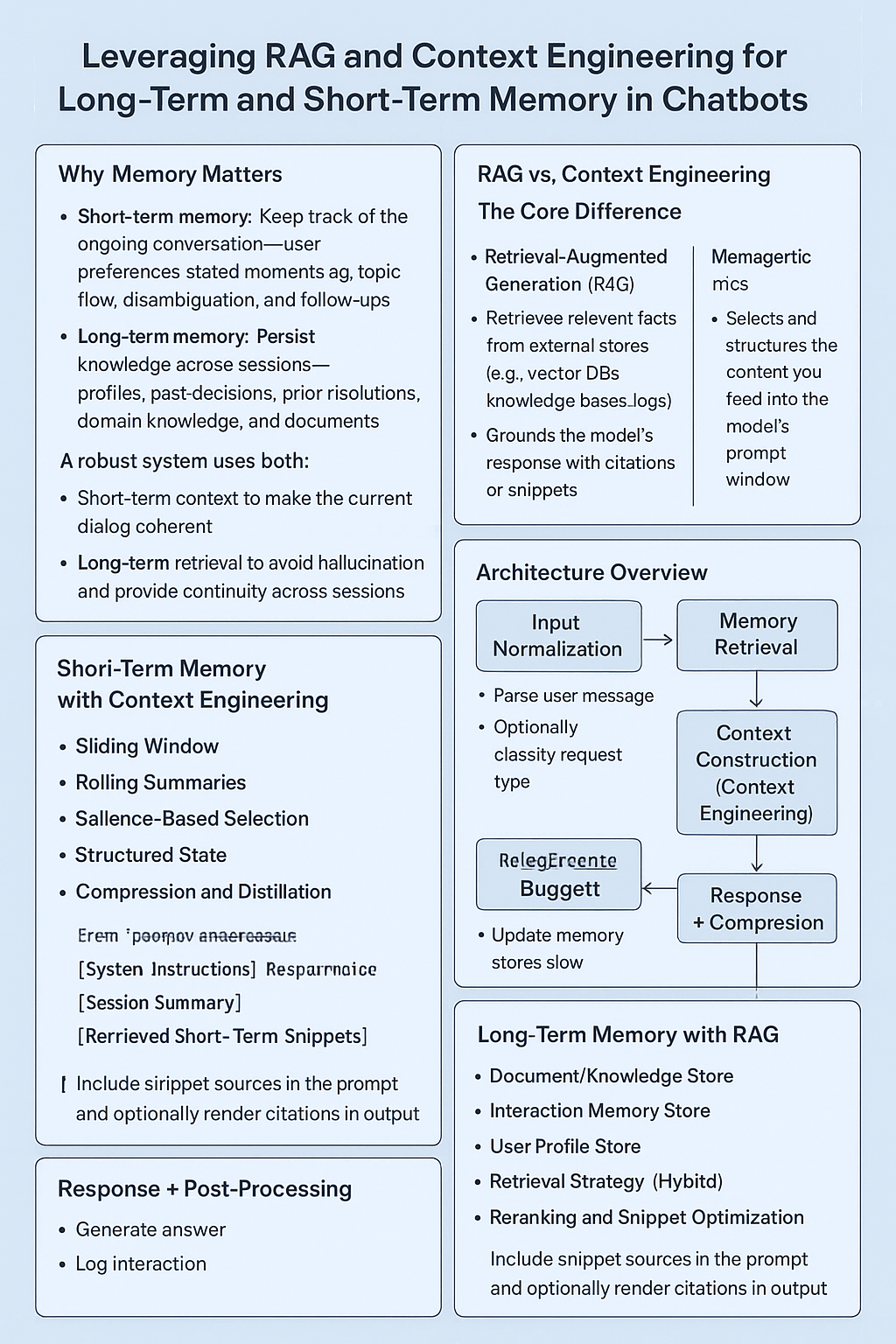
As chatbots become core to products and workflows, users expect them to remember past interactions, maintain continuity, and respond with relevant, accurate information. Achieving this requires a thoughtful memory architecture—one that distinguishes between short-term conversational context and long-term knowledge—while keeping hallucinations low and responses grounded.
This blog explores how to design chatbot memory using two complementary pillars:
Retrieval-Augmented Generation (RAG) for grounded, long-term memory
Context (prompt) engineering for effective short-term conversational memory
We’ll cover architectures, patterns, trade-offs, and practical implementation tips.
Why Memory Matters
Short-term memory: Keep track of the ongoing conversation—user preferences stated moments ago, topic flow, disambiguation, and follow-ups.
Long-term memory: Persist knowledge across sessions—profiles, past decisions, prior resolutions, domain knowledge, and documents.
A robust system uses both:
Short-term context to make the current dialog coherent
Long-term retrieval to avoid hallucination and provide continuity across sessions
RAG vs. Context Engineering: The Core Difference
RAG (Retrieval-Augmented Generation):
Retrieves relevant facts from external stores (e.g., vector DBs, knowledge bases, logs)
Grounds the model’s response with citations or snippets
Best for persistent, scalable long-term memory and domain knowledge
Context (Prompt) Engineering:
Selects and structures the content you feed into the model’s prompt window
Includes conversation summaries, instructions, and constraints
Best for ephemeral short-term memory and dialog control
Together, they solve: “what should the model know right now?” and “where does that knowledge come from?”
Architecture Overview
A practical memory architecture has four layers:
Input Normalization
Parse the user message, extract entities, intents, and conversation features.
Optionally classify request type (knowledge lookup vs. chit-chat vs. task execution).
Memory Retrieval
Short-term: Load relevant turns from the current session or a compact session summary.
Long-term (RAG): Retrieve from:
User profile store (key–value, relational DB)
Interaction history store (summaries + embeddings)
Domain knowledge base (documents, FAQs, code, policies)
Tool results cache (previous tool outputs)
Context Construction (Context Engineering)
Compose the prompt from:
System/policy instructions
Conversation state (short-term window or rolling summary)
Retrieved long-term snippets (RAG results)
Structured variables (time, user ID, preferences)
Enforce budgets: token limits, ranking, deduplication, and compression.
Response + Post-Processing
Generate answer.
Log interaction.
Update memory stores (write-back): embeddings, summaries, profile updates.
Short-Term Memory with Context Engineering
Short-term memory is governed by what goes into the prompt. Techniques:
Sliding Window
Keep the last N turns. Simple but grows cost linearly.
Use when conversations are brief or budgets are large.
Rolling Summaries
Maintain a compact summary of the dialog so far.
Update it after each turn with a summarization prompt or structured reducers.
Store both a “narrative summary” and “fact list” (decisions, preferences, entities).
Salience-Based Selection
Score recent turns by relevance to the current query (embedding similarity).
Select top K snippets to inject into the prompt.
Structured State
Maintain a state object (JSON) with:
user_profile: name, role, preferences
session_goals: active tasks, deadlines
working_memory: key facts derived this session
unresolved_items: pending questions
Serialize into the prompt as a compact block.
Compression and Distillation
Use chain-of-density or map-reduce summarizers to compress long context.
Deduplicate facts and normalize entities.
Example prompt skeleton:
[System Instructions]
You are a helpful assistant...

[Session Summary]
- User: Hritul Srivastava, Software Engineer
- Goals: Build a RAG chatbot
- Key facts: Prefers Python + FastAPI; using OpenAI embeddings

[Retrieved Short-Term Snippets]
1) Yesterday we designed the chunking strategy.
2) The user asked for hybrid search (BM25 + vector).

[Query]
User: “Can we persist preferences across sessions and surface them when relevant?”
Long-Term Memory with RAG
Long-term memory focuses on persistence, retrieval quality, and grounding.
Core components:
Document/Knowledge Store
Chunk documents (code/docs/wiki) with overlap.
Create embeddings for chunks; store metadata (source, timestamp, tags).
Optional: a BM25 index for keyword search to complement vector search.
Interaction Memory Store
Persist session summaries and salient facts after each conversation.
Embed summaries and tag with user, date, topic.
Enables “memory recall” across sessions.
User Profile Store
Key–value or relational DB for stable attributes (name, role, preferences).
Separate from the vector DB to avoid duplication.
Retrieval Strategy (Hybrid)
Vector search for semantic similarity
BM25 for sparse keyword matching
Use confidence thresholds and human-in-the-loop for sensitive data.
RRF (Reciprocal Rank Fusion) or weighted rank fusion to combine results
Filters: user_id, tenant, tags, recency
Reranking and Snippet Optimization
Use a cross-encoder reranker to boost precision@k.
Trim snippets to sentence boundaries; highlight answer-bearing spans.
Grounding and Citations
Include snippet sources in the prompt and optionally render citations in output.
This encourages faithful generation and boosts trust.
Write-Back Policy
After responding, decide what to store:
Stable user preferences (long-lived)
Derived facts (with evidence links)
Summaries of resolved issues
Orchestrating Short-Term and Long-Term Memory
A typical flow per turn:
Classify request: knowledge vs. task vs. chit-chat.
Build a retrieval query:
From current user message + session summary
Extract entities/intents to form filters
Retrieve:
Short-term: top recent turns or salient snippets
Long-term: RAG from knowledge base + interaction memory
Rerank and compress results to fit token budget.
Construct the prompt: instructions + short-term + long-term + user query.
Generate response.
Post-turn updates:
Update session summary and structured state
Persist new long-term memories when appropriate
Token budgeting tips:
Reserve budget slices: e.g., 20% instructions, 30% short-term, 40% long-term, 10% scratch space.
Apply adaptive compression: increase summarization when nearing limits.
Avoid redundant snippets with hash-based deduplication.
Context Engineering Patterns
Instruction Hierarchies
System > Developer > User messages
Keep policies stable and compact; externalize long policies as retrievable snippets
Schema-First Context
Use JSON schemas to pass state and retrieved facts, then render for the model.
Contrastive Context
Provide both positive and negative examples (do/don’t) to control behavior.
Disambiguation Primers
Encourage the model to ask clarifying questions if retrieval is low confidence.
Guardrails and Tools
Teach the model when to call tools (search, DB lookup) vs. answer from memory.
Include “if unsure, retrieve” guidance.
Data Modeling for Memory
Chunking strategy:
200–400 tokens per chunk with 10–20% overlap for general text
For code: function/class-level chunks with symbol tables and docstrings
Metadata:
user_id, tenant_id, security labels
source_url or doc_id, version, timestamp
embeddings model version
Fact Store (optional):
Normalize derived facts into subject–predicate–object triples
Supports graph queries and consistency checks
Privacy and Compliance:
Encrypt at rest, redact PII, respect retention policies
Provide user controls to view/delete personal memories
Evaluation and Quality Assurance
Measure both retrieval and dialog quality:
Retrieval metrics:
Recall@k, Precision@k, MRR, nDCG
Reranker ablations (on/off)
Generation metrics:
Faithfulness (citation grounding checks)
Hallucination rate, response latency, token cost
Memory utility:
Preference recall rate across sessions
Task success rate with/without long-term memory enabled
Human feedback:
Memory helpfulness ratings
“Creepy factor” checks (are we remembering too much?)
Implementation Blueprint
Example stack:
Embeddings: OpenAI, Cohere, or local (e.g., bge, e5) depending on constraints
Vector DB: Weaviate, Pinecone, Qdrant, Milvus, or pgvector
Sparse index: Elastic/Lucene/BM25
Reranker: Cross-encoder (e.g., Cohere Rerank, bge-reranker)
Orchestration: LangChain, LlamaIndex, custom pipelines
Storage: Postgres for profiles; object store for raw docs
Observability: Tracing (Langfuse), eval harness, LLM-as-judge for faithfulness checks
Pseudo-flow in code:
def handle_turn(user_id, message):
    # 1) Load session summary + state
    session = load_session_state(user_id)

    # 2) Build retrieval query (combine message + summary entities)
    query = build_query(message, session.summary)

    # 3) Retrieve
    short_term = retrieve_short_term(session.history, message)
    long_term_docs = hybrid_retrieve_docs(query, user_id)
    past_memories = retrieve_interaction_memories(user_id, query)

    # 4) Rerank + compress
    candidates = rerank_and_merge(short_term, long_term_docs, past_memories)
    context = compress_to_budget(candidates, token_limit=6000)

    # 5) Prompt assembly
    prompt = render_prompt(
        system_instructions=BASE_SYSTEM_PROMPT,
        session_summary=session.summary,
        retrieved=context,
        user_message=message,
        user_profile=session.profile,
    )

    # 6) Generate
    response = llm(prompt)

    # 7) Post-turn updates
    session.summary = update_summary(session.summary, message, response)
    write_long_term_memories(user_id, message, response, confidence=0.8)
    save_session_state(user_id, session)

    return response
Common Pitfalls and How to Avoid Them
Overfitting memory:
Don’t store everything; store salient, stable facts with confidence thresholds.
Token bloat:
Aggressive dedup + summarization; keep instruction blocks minimal.
Stale facts:
Version documents; favor recent entries; decay old memories.
Leakage and privacy:
Implement per-tenant isolation, PII redaction, and user-controlled deletion.
Hallucinations despite RAG:
Train the model to abstain without high-confidence evidence.
Include “answer only with cited sources” mode for critical domains.
Advanced Enhancements
Multi-Vector Indexing
Store multiple embeddings per chunk: title, body, headings, entities.
Intent-Aware Retrieval
Switch retrieval pipelines by intent: troubleshooting vs. how-to vs. policy.
Memory Graphs
Convert derived facts into a knowledge graph; use graph traversal for recall.
Continual Learning Loop
Periodically distill high-value memories into curated docs for RAG.
Personalized Reranking
Train rerankers with user-specific interaction data for better relevance.
Conclusion
Long-term and short-term memory in chatbots isn’t just about stuffing more tokens into the prompt. It’s a disciplined approach that combines:
Short-term context engineering to maintain dialog coherence and task focus
Long-term RAG to ground responses, reduce hallucinations, and persist knowledge
By orchestrating retrieval, summarization, and prompt construction—with careful token budgeting, privacy controls, and evaluation—you can build chatbots that feel truly attentive, consistent, and trustworthy over time.
If you’d like, I can provide a starter template (Python/FastAPI) with a RAG + context-engineering pipeline and evaluation harness.
